
The Conjugal Rights is the cornerstone of matrimonial law in many jurisdictions worldwide. In India, the enforcement and interpretation of conjugal rights after intersect with deeply ingrained culture, social and legal norms. Conjugal Rights refer to the right that spouses have within in marriage, including sexual, emotional, and physical companionship. In the India context , Conjugal Rights have been interpreted as essential to the sanctity of marriage and marital duty, ensuring the preservation of families structures and the continuation of familial structure and the continuation of lineages.
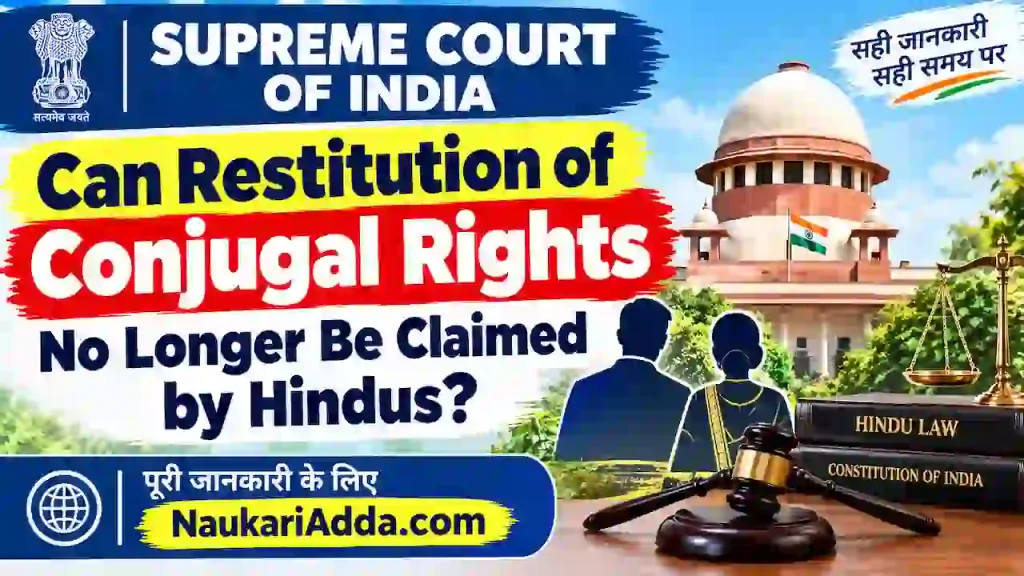
However, in a modern context with evolving views on marriage, gender roles, and personal autonomy, the concept of conjugal rights has come under scrutiny.
Table of Contents :-
- Introduction
- Legal framework of Section 9 Under Hindu Marriage Act ?
- Does the remedy of Restitution of Conjugal Rights interfere with an individual’s right to privacy, dignity and personal autonomy ?
- To what extent does Restitution of Conjugal Rights serve the objective of preserving the institution of marriage ?
- How should the law balance the preservation of marital relationships with the individual autonomy and liberty of spouse ?
- Does the existing framework of Restitution of Conjugal Rights remain consistent with contemporary constitutional values ?
- Does Section 9 require judicial reconsideration or legislative reform in light of evolving constitutional jurisprudence ?
- Conclusion
Legal framework of Section 9 under Hindu Marriage Act , 1955 ?
Section 9 of According to Hindu Marriage Act, 1955 :-
“When either the husband or the wife has, without reasonable excuse, withdrawn from the society of the other, the aggrieved party may apply, by petition to the district court, for restitution of conjugal rights and the court, on being satisfied of the truth of the statements made in such petition and that there is no legal ground why the application should not be granted, may decree restitution of conjugal rights accordingly .”
(Explanation – Where a question arises whether there has been reasonable excuse for withdrawal from the society, the burden of proving reasonable excuse shall be on the person who has withdrawn from the society. )
In Indian Legal Perspective, conjugal rights are recognized as part of the marital contract. The most notable laws that governs there rights include –
- Hindu Marriage Act, 1955
- Special Marriage Act. 1954
- Indian Divorce Act, 1869
These laws provide a legal framework for enforcing conjugal rights through the courts.
In Reference to Section 9 , where one spouse denies the other their conjugal rights, the aggrieved party may apply petition to the court. for restitution of conjugal rights, compelling the other spouse to resume married life- cohabitation, live together as husband and wife , appear to society as a married couple.
This provision has been controversial over time particulary, because it mandates cohabitation and does not fully account for issues such as physical abuse, emotional trauma, as lack of consent , individuality and equality rights.
Does the remedy of Restitution of Conjugal Rights interfere with an individual’s right to privacy, dignity and personal autonomy ?
Ha, yeh Restitution of Conjugal rights ka core constitutional question hai .
Position to support basic structure doctrine of Indian Constitution
The strongest argument against Restitution of conjugal rights ( Section 9 ) is that marriage does not eliminate Individual’s Independent Constitutional Identity .
The right to Privacy ( Article 21 of Indian Constitution ) includes a sphere in which an individual should be able to make concentual intimate and personal decision without unjustified state interference.
Position to support Section 9
The counter – argument is that Section 9 does not expressely authorised forced sexual intercourse with your partner.
This distinction was important in Saroj rani v. Shudarshan kumar Chadha, 1984
The Supreme Court observed that the remedy concerns cohabitation and consortium and that courts cannot physically compel sexual intercourse. The Court therefore rejected the argument that Section 9 necessarily constitutes a direct governmental enforcement of sexual relations.
Most important contemporary question arises that, Even if physical sexual intercourse cannot be compelled, does the legal pressure created by an Restitution of Conjugal Rights decree nevertheless interfere with decisional individual’s autonomy and intimate privacy?”
To what extent does Restitution of Conjugal Rights serve the objective of preserving the institution of marriage ?
The preservation of marriage is the Hindu traditional justification for Restitution of Conjugal Rights. The law assumes that when spouses separate without reasonable cause, judicial intervention may provide an opportunity for reconciliation.
A legal decree can make an opportunity for reconciliation, but it cannot create:
- emotional and physical affection,
- trust,
- free consent,
- or genuine marital companioship
How should the law balance the preservation of marital relationships with the individual autonomy and liberty of spouse ?
The law must recognise that both interests are constitutionally and socially significant.
Interest in preserving marriage
Marriage is an important social institution, and the State may legitimately create legal mechanisms to support reconciliation.
Interest in Individual autonomy
Constitution recognises that an individual does not surrender fundamental dignity and personal liberty merely by entering into marriage relationship.
The modern understanding of Article 21 requires respect for personal autonomy.
The Supreme Court has repeatedly linked dignity with the freedom to make essential personal choices.
Courts should ask:
- Is there a legitimate purpose behind the remedy?
- Is preservation of marriage a legitimate State objective?
- Does the particular application of Restitution of Conjugal Rights interfere with privacy or autonomy?
- Is that interference proportionate?
- Are there less intrusive methods, such as mediation or counselling, to achieve reconciliation ?
Does the existing framework of Restitution of Conjugal Rights remain consistent with contemporary constitutional values ?
Arguments Supports to continued Validity:-
- Gender Equality
- Legitimate obbjective
- Judicial precedents
- No physical compulsion
Arguments supporting reconsideration:-
- Expanded privacy jurisprudence
- Increased recognition of autonomy
- Dignity
- Possibility of Indirect coercion
- Changing understanding of marriage
Does Section 9 require judicial reconsideration or legislative reform in light of evolving constitutional jurisprudence ?
- Re – examination by the judiciary:-
A future constitutional challenge could examine Section 9 through the modern framework of:
- Article 14,
- Article 21,
- privacy,
- dignity,
- decisional autonomy,
- proportionality.
2.Greater efforts for mediations
3.Greater consideration of the reason for withdrawal
4.stronger protection against abuse
Conclusion
There is a proverb “one can led a horse to the river but can’t compel it to drink”.
The constitutional validity of Restitution of Conjugal Rights under Section 9 of the Hindu Marriage Act continues to raise a significant conflict between the preservation of marriage and individual autonomy. Restitution conjugal Right cannot be understood merely as a mechanism for preserving marriage without considering the personal liberty and dignity of the spouses. The contemporary application of Section 9 must therefore maintain a careful balance between matrimonial obligations and constitutional freedoms. A rights-sensitive and autonomy-oriented approach is essential to ensure that the preservation of marriage does not become a source of undue coercion.
Why is Section 9 constitutionally controversial?
It creates a conflict between the preservation of marriage and the individual’s rights to privacy, dignity and personal autonomy.
Can a spouse be physically forced to return to the matrimonial home?
No, the law does not permit physical force to compel matrimonial cohabitation.
Is Section 9 gender-neutral?
Yes, both husbands and wives can seek a decree of Restitution of Conjugal Rights.
Disclaimer: Naukari Adda (https://www.google.com/search?q=naukariadda.com) is an educational and news informative website. We are not associated with any government organization. All the information provided here is collected from various official websites and newspapers. While we try our best to provide accurate information, please always verify the details on the official website before applying for any job. We are not responsible for any error or loss.